
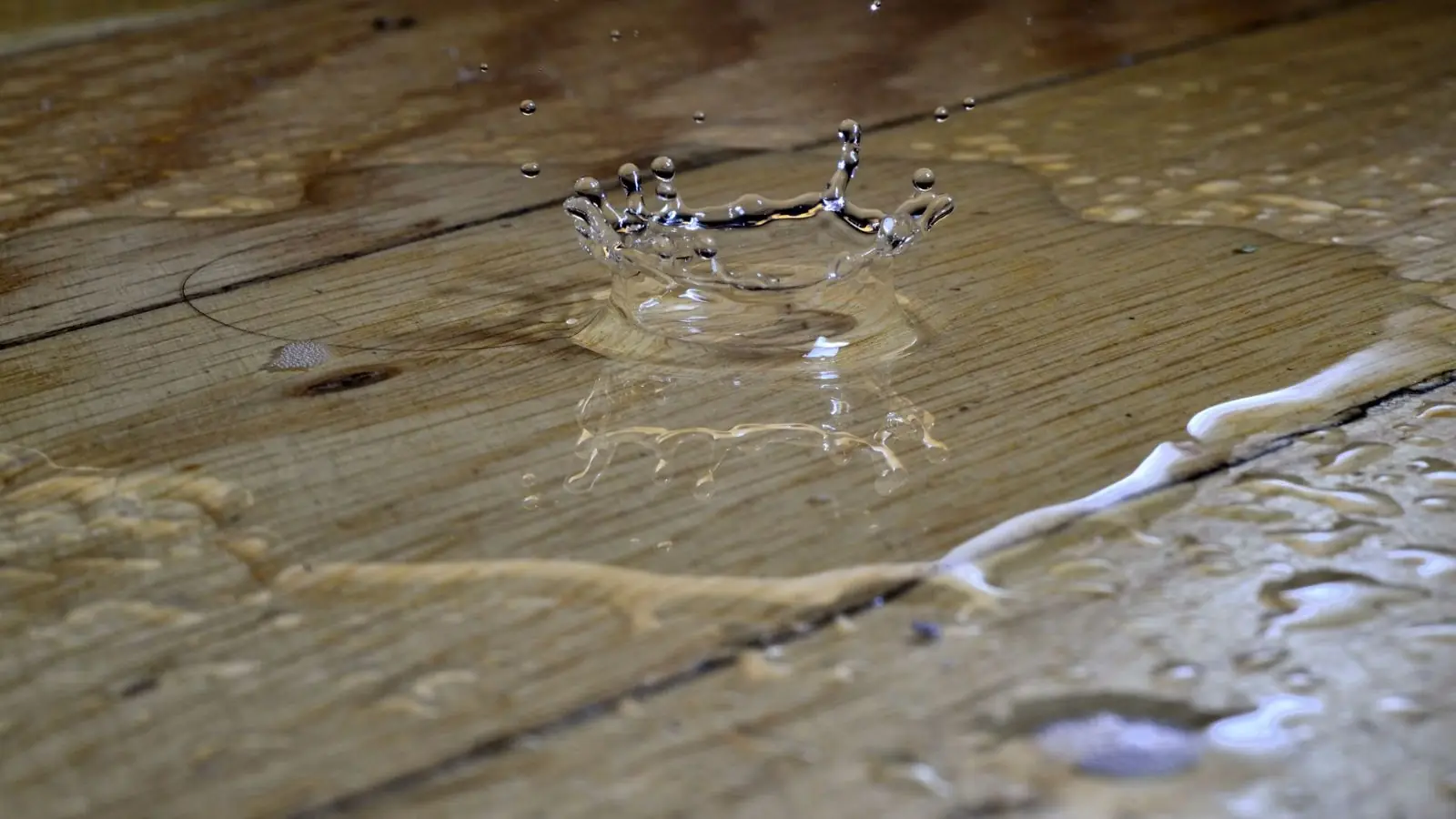
What cupping and crowning tell you
Hardwood is wood, and wood swells when it takes on moisture. If water reaches the underside of a board, the bottom face swells first and the edges rise, which gives the shallow tray shape called cupping. Crowning is the reverse, with the center of a board sitting higher than its edges.
Both shapes describe moisture, not a final verdict on the floor. A cupped board that is still damp inside can relax as it dries, while a floor sanded flat over a wet core can crown weeks later. That is why moisture readings matter more than appearance.
Before anyone sands, patches or refinishes, the boards, the subfloor and the air all need readings that match a dry reference spot elsewhere in the house.
The first day after a leak or flood
Stop the source first. For a dishwasher line, a water heater or a supply hose, that means closing the nearest shutoff or the main valve, and if you cannot find the main, the provider on your water bill can tell you where it sits. Then get standing water off the floor with towels, a wet vacuum or a mop, and keep foot traffic to a minimum because wet boards scratch and dent easily.
Lift rugs, furniture legs and anything that traps water against the surface. Photograph the wet area and the source with date-stamped photos before you clean up, since your insurer may ask for them.
Water and electricity
Water near outlets, baseboard heaters or a panel is an electrical hazard. Keep out of the room, phone 911 or the electric company first, and never wade to a breaker.
How wet hardwood is dried
Drying is a controlled process, not a race to the hottest fan. A crew starts by mapping moisture with a pin or pinless meter and a thermal imaging camera, which shows cool, wet zones you cannot see. Those readings set the plan and become the baseline you compare against at the end.
On solid plank floors, technicians often use floor drying mats or panels that pull moisture from the board faces while dehumidifiers remove it from the air. Axial air movers keep air sliding across the surface, and LGR or desiccant dehumidifiers hold humidity low enough that water keeps leaving the wood. Pulling a few baseboards and drilling small ventilation holes can help dry cavities under cabinet toe kicks.
Engineered flooring behaves differently because the layers react at different rates, and glued-down floors over a slab can trap water between the boards and the concrete. Tell the crew which type you have and what lies under it.
Decision table: hours wet and water category
No chart replaces readings, but this table shows how the two biggest factors usually steer the outcome. Categories follow the ANSI/IICRC S500 standard, which sorts water from clean (Category 1) to grossly contaminated (Category 3).
| Situation | Hours wet | Usual direction |
|---|---|---|
| Category 1 supply line, small area | Under 24 | Dry in place with mats and dehumidification |
| Category 1, larger area or glued floor | 24 to 72 | Dry in place, then test, with some boards at risk |
| Category 1, long exposure | Over 72 | Expect cupping, plan for replacement of damaged boards |
| Category 2 (washer or dishwasher discharge) | Any | Clean and sanitize, watch closely, replacement more likely |
| Category 3 (sewage or floodwater) | Any | Remove affected flooring, then dry what remains |
Not sure which row you are in?
Tell us what the floor is made of, where the water came from and how long the boards sat wet. You hear the plan and the scope first.
When boards come out and when they stay
A board stays when its moisture reading returns to the dry reference and its shape settles. Mild cupping often relaxes over several weeks of controlled drying, so patience can save a floor that looks hopeless on day three. A board comes out when it is split, delaminated, stained from contamination or still wet after the rest of the room is dry.
Sanding too early is the most common regret. If the floor is flattened while still holding water, it can crown as it finishes drying, and the extra sanding thins the wear layer. A short wait after dry readings protects the investment.
Replacement is rarely only about the floor you see. Wet baseboards, cabinet kicks and the subfloor often need attention too, which is where water damage repair picks up once drying is complete.
Cost factors without the guesswork
- Water category, since contaminated water forces removal
- Square footage and how many rooms the wet floor runs through
- Board type (solid, engineered, glued or floating) and thickness of the wear layer
- Drying days and the amount of equipment the room needs
- How much refinishing or replacement is left after drying
A word on coverage: a burst line or an appliance failure is the kind of abrupt event policies often pay for, a seep that went unnoticed for months often falls outside them, and rising floodwater typically needs its own policy. Check your policy or ask your insurer before assuming either way. Want your real number? Call (909) 505-3870.
Yucaipa note: moisture and the seasons
Southern California homes dry fast in summer and sit in damp air during winter storms, and the mountains above Yucaipa make winter rain a real part of the local picture. A floor wetted by a burst line in January dries differently from the same leak in July, so crews take readings of the room, not only the floor.
Water and sewer lines in the city belong to Yucaipa Valley Water District, so a mystery leak under a floor is worth mentioning to your provider as well as a plumber. If you plan to tear out and replace a large stretch of flooring, phone the city's Community Development staff and ask whether a permit is needed.
Sources: the water district boundary filing kept at the county LAFCO, and Yucaipa's list of city departments.
Frequently Asked Questions
Often, yes. Mild cupping tends to relax as boards dry under controlled conditions, and a floor is usually judged again after readings return to normal. Boards that are split, delaminated or contaminated generally have to be replaced.
It depends on the species, thickness, subfloor and how long the boards sat wet. Many floors need several days of equipment time, and some need weeks before they are ready for sanding. Your crew compares readings against a dry reference spot to decide.
Not on humid or rainy days, because outside air can add moisture. In dry weather a little ventilation helps, but controlled dehumidification is more predictable than open windows.
For tight solid-wood boards, mats and panels pull moisture from the surface while fans and dehumidifiers handle the air. Fans alone can dry the top of a floor while the underside stays wet.
Usually not. Equipment is noisy and the room may be off limits, but most homes stay occupied. Category 3 water is the exception, and the crew will tell you which rooms to avoid.
Still have a question?
Call the 24/7 emergency line and ask. Scope and price are explained before work starts.