
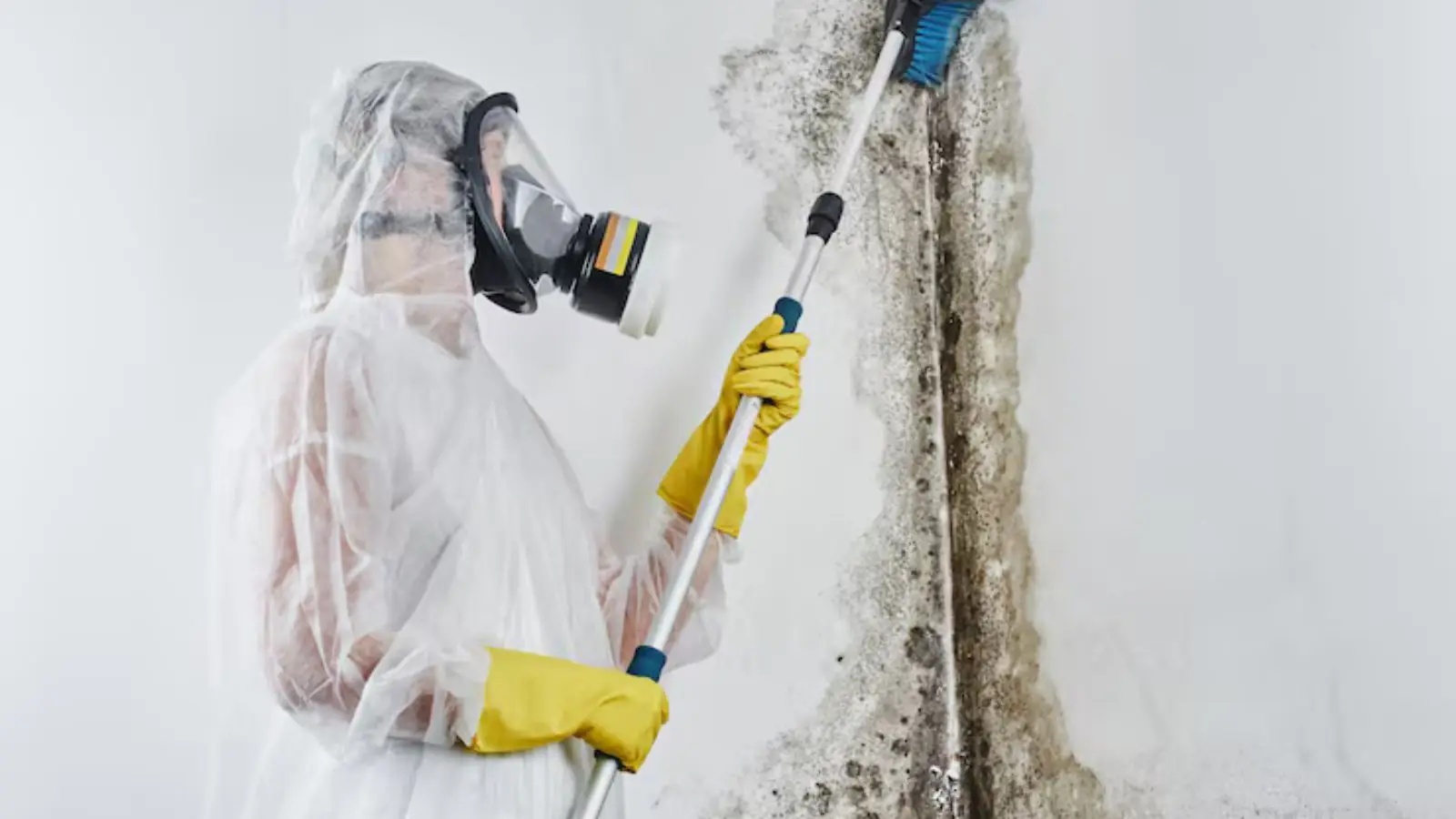
Why color is a poor guide
Callers often describe a closet wall with dark spots and ask if it is the dangerous kind. Color alone cannot answer that. Many mold types look dark, and several look green, white or gray, so a lab or a trained technician is the only way to name a species. For the cleanup decision, species rarely matters as much as how much there is and why it grew.
That is why this article treats 'black mold' as a label for dark visible growth rather than a diagnosis. Health questions belong to a physician. What a homeowner can control is the moisture and the way the growth is removed.
Moisture first, always
Mold needs moisture to grow, and no cleanup beats a wet wall. The usual suspects in a house are an air conditioner condensate line that backs up, a slow leak under a sink, a roof leak or a closet wall that stays cool and damp. Fix that first, then deal with the growth.
Dry the area and confirm it with a moisture meter. A wall reading high on the meter after you have wiped it clean is still a mold wall waiting to happen. The water mitigation process is often the missing piece, because it dries the structure instead of just the surface.
What a professional removal involves
Professional work for mold follows the ANSI/IICRC S520 standard. The aim is to remove growth without spreading it, and every step is built around that idea.
Containment
Plastic barriers seal the work area from the rest of the home, with controlled entry points.
Negative air
A machine pulls air out of the contained space through a HEPA filter so air flows in, not out.
Removal and cleaning
Porous materials such as affected drywall are cut out and bagged. Cleanable surfaces get HEPA vacuuming and damp wiping.
Drying and verification
The structure is dried, readings are recorded and the area is prepared for repair.
Afterward, many jobs include clearance testing, ideally by a third party who does not do the cleanup, to show the air and surfaces are back to normal levels. Our mold remediation page details how those steps fit together for a house.
Testing versus looking
| Method | What it tells you | When it makes sense |
|---|---|---|
| Visual inspection and moisture readings | Where growth is and why it is wet | Almost every job starts here |
| Surface or tape sample | Whether a spot is mold and roughly what kind | When you are unsure what the spot is |
| Air sampling | Spore levels in the air compared to outdoors | Before and after large cleanups, or for sale and loan paperwork |
| Post-removal clearance test | Whether the cleanup met its goal | After a contained removal, ideally by an independent tester |
What changes the scope and cost
- How much material is affected and how far it runs behind walls or ceilings
- Whether the growth is on cleanable surfaces or in porous drywall and insulation
- How many days of drying and equipment the structure needs
- Access, such as attic, crawl space or finished rooms, and how much needs rebuilding
- Whether testing is required for a sale, loan or insurance conversation
For a real figure on your house, call (909) 505-3870. Those factors drive the price, and the scope is explained first. Coverage is a matter for your policy: insurers often respond to sudden events and not to long-running leaks, so ask yours.
Hidden leaks and Yucaipa water bills
Inside Yucaipa and Calimesa the Yucaipa Valley Water District handles both water and sewer, and the name on your monthly bill tells you who your provider is. A bill that creeps up with no change in habits is a cheap early warning of a hidden supply-line leak, the kind that feeds mold behind a wall for months.
If the bill shows a jump, shut off water use in the house and see if the meter keeps moving. A moving meter with every fixture off means water is going somewhere it should not, and a moisture survey can tell you where.
Source type: LAFCO service-area staff report for the water district.
Dark growth you cannot explain?
Call the 24/7 line and describe what you see. We start with moisture readings.
Crews work in homes across Redlands and Beaumont as well as Yucaipa. Wherever the house sits, the order stays the same: find the water, dry it, remove the growth in containment and confirm the result.
Safety checklist before you touch any mold
- Fix or shut off the water source first, otherwise the mold returns to a wet surface.
- Wear gloves, goggles and an N-95 respirator, following EPA guidance.
- Never mix bleach with ammonia or other cleaners.
- Keep the HVAC fan off in that room so spores do not travel through the ducts.
- Stop and call a professional if the area is larger than about 10 square feet.
Frequently Asked Questions
In everyday talk the phrase covers dark-colored growth. Only testing identifies species, and the removal approach depends mostly on the extent and the moisture source.
For a small visible patch, EPA's homeowner guidance points to detergent, water and protective gear. Anything bigger than roughly ten square feet, or growth you cannot see, is work for professionals.
The moisture source was likely still active, or material behind the surface stayed damp. A meter reading shows whether the wall is truly dry.
Not always. Testing is useful when growth is hidden, the scope is unclear or a buyer, lender or insurer needs it. Ask who will do the testing and whether they are independent from the cleanup.
Yes. A small supply-line leak inside a wall can run long before any stain appears. A water bill that rises without a reason, or a meter that moves with everything off, are two early signs.
Still have a question?
Call the 24/7 emergency line and ask. Scope and price are explained before work starts.