
What the first phone call sets in motion
A mitigation visit starts before the truck arrives. When you call the 24/7 line, the dispatcher asks where the water is coming from, whether it has stopped, which rooms are wet and whether anyone has noticed sewage or a gas smell. Your answers decide which pumps, how many fans and what protective gear go on the truck.
Until the crew pulls up, close the home's main supply if a broken pipe is feeding the problem, and stay out of any room where water reaches an outlet. A gas smell or visible sparking means you walk outside and dial 911 before anything else. Our water mitigation page lists the first-hour checklist in more detail.
Arrival: make it safe, then map the damage
The crew confirms the source is controlled and the work area is safe before anything else. Then a technician walks room by room, pressing a pin-style meter against walls, floors and ceilings and scanning with an infrared camera. Every reading gets a number, and the infrared view shows cool damp patches that paint hides.
Those numbers go onto a moisture map, a simple sketch of your home with the wet areas marked. It tells the crew where equipment belongs, and it gives you a baseline to compare against later. The same process applies whether the loss is on Yucaipa Boulevard or across the line in Calimesa.
Extraction comes before drying
Standing water goes first. Deeper pooling gets a submersible pump, while soaked carpet, pad and hard flooring are worked with a van-mounted or carry-in extractor. Pulling water out mechanically removes far more than a fan can evaporate, and that saves drying days.
Wet carpet pad is usually removed because it holds water like a sponge and costs little to replace. The carpet on top is sometimes saved when the water was clean and the response was quick. That is a judgment call made with you, based on the water category in the ANSI/IICRC S500 standard.
| Stage | What happens | What you will see |
|---|---|---|
| Assess | Moisture mapping of every affected room | Moisture meters and a thermal imaging camera |
| Extract | Standing water pulled out of floors and carpet | Submersible pumps and extraction units |
| Open up | Wet drywall, pad or baseboard removed where needed | Hand tools and HEPA vacuums |
| Dry | Warm dry air circulated and humidity pulled out | Air movers and LGR dehumidifiers |
| Verify | Daily readings until materials match a dry standard | Moisture meters and a written log |
Opening walls and setting up the drying system
Some materials cannot dry in place. Drywall that has wicked water upward, insulation soaked inside a wall cavity and baseboards that trap moisture against the wall are often cut out so air can reach the framing. The technician checks the meter as the cut moves upward and stops where readings are normal.
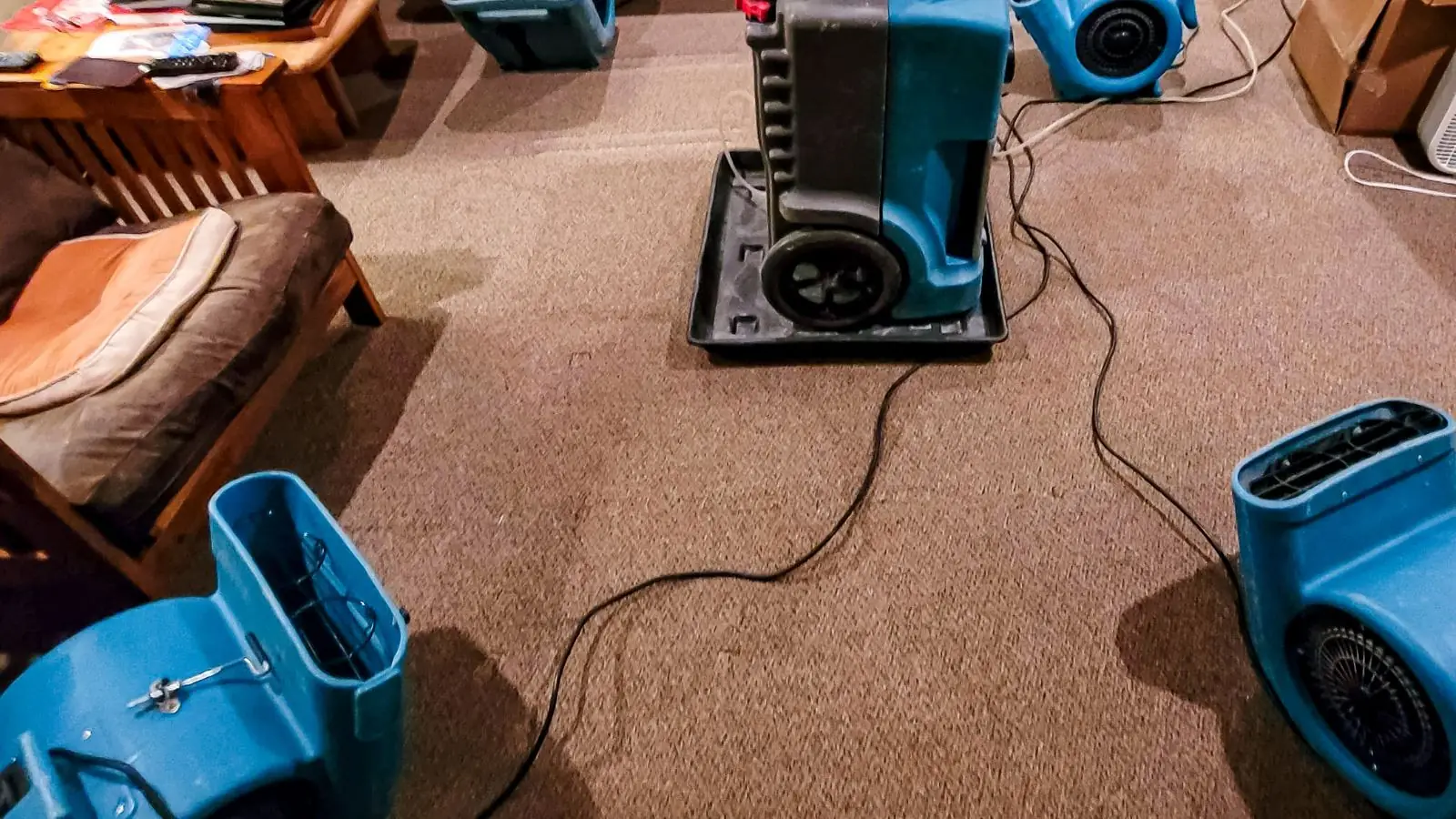
Air movers are the loud fans on the floor, and they push air across wet surfaces. LGR dehumidifiers pull that moisture out of the air and drain it away. Working together in a closed room, the two dry a structure in a controlled way that box fans and a shop vacuum cannot match.
Monitoring visits and the paper trail
A technician returns on a schedule to read the meters, move equipment and pull gear out of rooms that reached their goal. If a wall is not drying, the plan changes, which might mean another opening or a different machine placement. Nothing about the process is finished until the numbers say so.
Ask for the moisture map, each day's readings, the photos and the equipment list. Your insurer will want that record, and so will you if a question comes up about whether a room was fully dried. Take your own photos before cleanup starts as well.
What Yucaipa homeowners should know before a mitigation call
Yucaipa homes are served by the Yucaipa Valley Water District, a utility that also reaches into Calimesa, for both taps and sewer lines. The bill in your mailbox names who serves you, and that provider can point out where your property's main shutoff sits. Locate it on a calm day, because finding it with water running costs minutes you do not have.
Once drying ends and rebuilding begins, a short call to Yucaipa's Community Development office tells you whether the repair needs a permit. Making that call before new drywall goes up is far easier than opening a finished wall later.
Source type: water district service-area filing with the county LAFCO, and the City of Yucaipa department listing.
Questions to ask any mitigation company
- Do your crews work to the ANSI/IICRC S500 standard for water damage restoration?
- Will I receive a written scope and the moisture readings, including the daily log?
- How do you decide which materials come out and which stay?
- What happens if a room is not drying on schedule?
- Who explains the scope and price before work begins, and how is it put in writing?
A company that answers these without hedging has a process. One that dodges them is asking you to trust the invoice. If the loss is large, water damage cleanup and rebuilding come next, and a clear handoff from mitigation makes those steps cheaper.
Ready to talk it through?
Tell us what is wet, and you will hear the scope and price before anyone starts work.
People sometimes ask whether the crew that dries a home will also rebuild it. Often the answer is yes, but it is a separate scope. The final bill is easier to understand when mitigation and repair are written up as two stages with their own line items.
Homes in Mentone and the rest of our service area get the same sequence. The only things that change are the size of the loss and the materials in the house.
What to do while you wait for the mitigation crew
- Close the main water valve if the source is a supply line.
- Move electronics, papers and small furniture to a dry room.
- Leave wet drywall and flooring in place so the crew can measure it.
- Photograph the damage and note when you first noticed it.
- Send children and pets to another room if the water came from a drain, toilet or outdoors.
Frequently Asked Questions
It depends on the water category, the materials and the humidity in the house. Drying often runs several days, and the readings decide when the equipment can leave, not a calendar.
Not always. If sewage or floodwater is involved, or if large areas are open, staying elsewhere is easier. For a small clean-water loss many people stay put, though the equipment is loud and runs day and night.
No. Mitigation stops the damage and dries the structure. Restoration rebuilds what had to be removed. They are often done by the same company but should be scoped separately.
Air movers and dehumidifiers do use electricity while they run. Ask the crew how many machines are planned so you can expect it, and tell your insurer if the loss is a covered claim.
Your water bill names your provider. If your home is on the Yucaipa Valley Water District system, which serves Yucaipa and Calimesa, start with the district. For a pipe inside the house, the shutoff on your own property is the fastest option.
Still have a question?
Call the 24/7 emergency line and ask. Scope and price are explained before work starts.